
RAINWATER OZONE TREATMENT
Eight years of drinking rainwater
Could rainwater become our everyday household water without chlorine, expensive filters or constant maintenance?
At Tanča Gora, almost all water is a resource worth keeping. Rain falling on our roofs is collected and stored rather than simply allowed to run away.
But collecting water is the easy part. If you want to use it every day — including as drinking water — keeping thousands of litres fresh over long periods becomes a much more interesting problem.
The problem
Before we built our ozone system, we treated the stored rainwater much more conventionally.
We regularly chlorinated it and used relatively expensive microbiological and activated-carbon filters that needed to be replaced. Despite all of that, the stored water would occasionally develop an unpleasant smell.
It worked, but it was neither particularly simple nor particularly elegant.
So we started experimenting with ozone.

The system
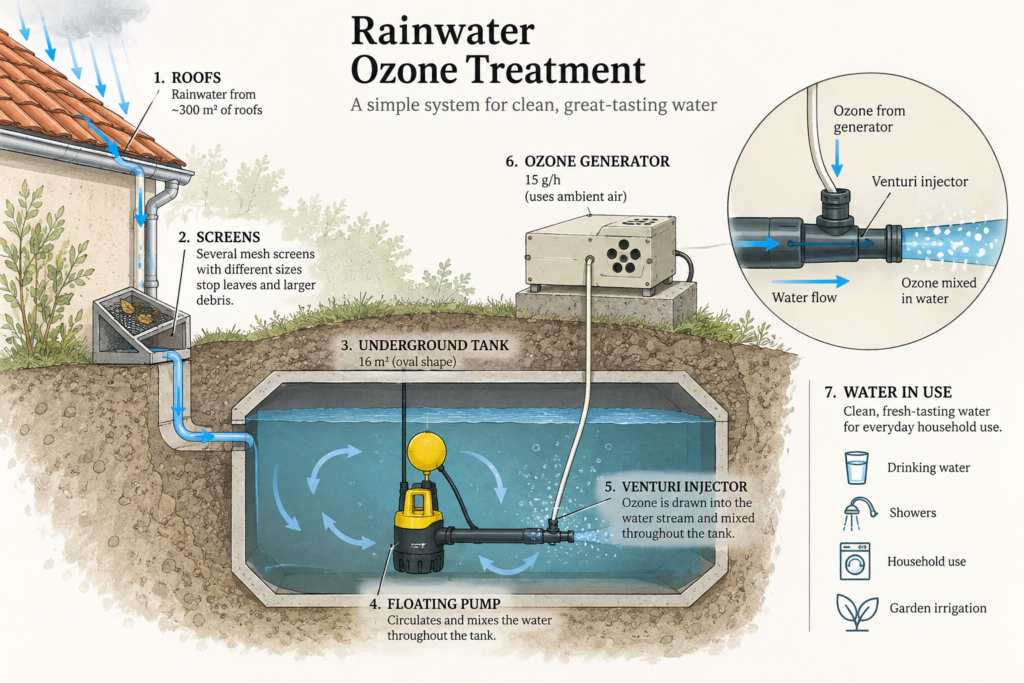
Today, rainwater from around 300 m² of roofs is collected into a 16 m³ underground tank.
Before entering the tank, the water passes through several screens with progressively different mesh sizes. Their job is deliberately simple: stop leaves and larger debris from the roofs before they reach the tank.
There is no complicated filtration plant between the roof and the cistern.
Inside the tank is a floating submersible pump. The pump circulates and mixes the stored water while a Venturi injector draws ozone into the water stream.
The ozone itself is produced from ambient air by a 15 g/h ozone generator.
Because the pump floats and continuously moves the water while operating, it creates enough circulation for the ozonated water to mix throughout the tank rather than treating only one small area.
We don’t treat water continuously
The ozone generator does not need to run all the time.
After significant rainfall, we normally run the system for a few hours. Between rain events, we ozonate the tank periodically — roughly once every two weeks.
That is essentially it.
Electricity consumption is negligible in the context of the homestead, there are no filter cartridges to replace, and the system requires virtually no routine maintenance.
Even cleaning the underground tank has become something we rarely need to do.


Eight years later
We have now been treating our rainwater this way for about eight years.
During that time we have had no problems with the stored water. It remains clear, has no unpleasant smell and, unlike chlorinated mains water, has no chlorine taste.
Guests regularly comment on how good the water tastes. To us, it tastes much more like water from a spring than something that has passed through a conventional treatment system.
Perhaps the most satisfying part is how little machinery is required to achieve it.
A tank.
A pump.
A Venturi injector.
An ozone generator.
And some very simple screens before the water enters the tank.
Simple doesn’t mean primitive
This project became a good example of something we keep discovering at Tanča Gora: a system doesn’t necessarily become better when you add more components to it.
Our previous solution relied on chemicals, several filters and consumables that had to be regularly replaced.
The current one relies mostly on circulation, oxidation and occasional operation.
It is simpler, cheaper to operate and has required remarkably little attention over eight years.
Sometimes the best automation is a system that hardly needs you at all.